numbers and benchmarks
How many lessons a week can one school horse actually carry before he sours?
Work limits for lesson horses rest on age, conditioning, rider weight and the kind of work asked. Here is how to set a defensible weekly ceiling per horse and track it.
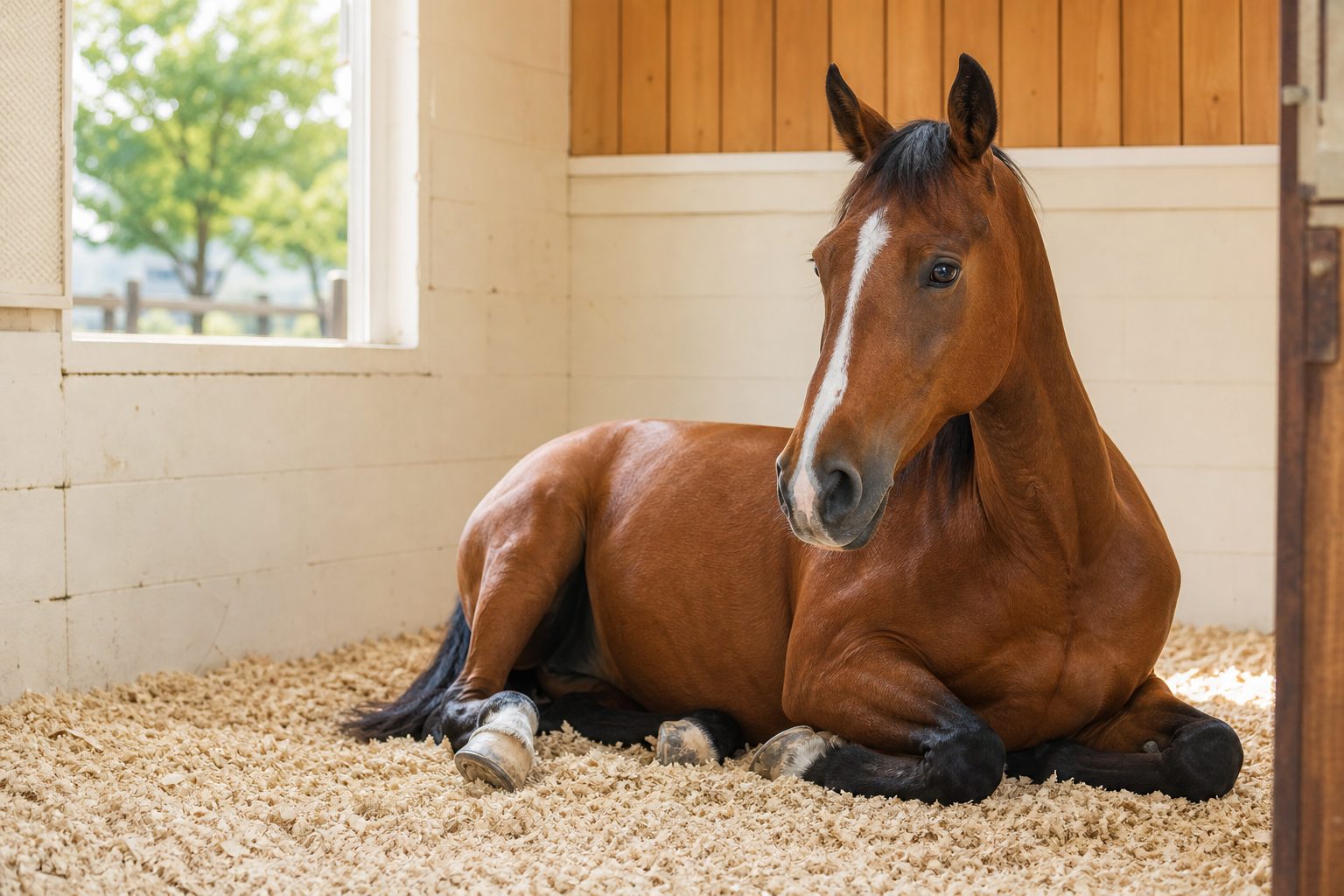
For a sound, well conditioned school horse between roughly 8 and 16 years old, carrying beginner and advancing beginner riders in an indoor or all weather arena, a defensible working ceiling is about 12 to 15 lesson hours a week, with a hard cap of three lesson hours in any single day and at least one full day off. That is the honest middle of the range, and most barns that keep horses in the program for a decade sit inside it.
The number moves. A 20 year old with old ringbone might sit at six hours. A rising 10 year old Haflinger carrying small children in walk and trot might carry 18 without complaint. Hours alone do not measure load. What you actually cap is hours weighted by what happens inside them.
The thing that sours a horse is rarely the total. It is the pattern: the same rider type, the same twenty meter circle, the same 6pm slot, and a schedule that quietly grows because he is the safe one and everyone asks for him. Here is how to set a ceiling per horse and keep it from evaporating on a busy Saturday.
What counts as a lesson hour versus a schooling hour
Start by separating the categories, because they load the horse differently and they are usually tracked by different people.
A lesson hour is one scheduled lesson slot with a paying student. In most US lesson barns that is a 45 or 60 minute slot with 30 to 40 minutes of actual mounted work once you subtract mounting, stirrup adjustment, walk breaks and the instructor talking. Call it 35 minutes of real work per hour slot.
A schooling hour is a staff or working student ride to keep the horse tuned. It is often harder than a lesson, because a competent rider actually asks the horse to use itself. Twenty minutes of correct schooling can cost more than a full beginner lesson.
A lease hour is time under a half leaser or full leaser, and it is the one that most often goes uncounted, because it lives in a different calendar. If you count only lesson hours, you underreport the horse's real week by whatever your leasers and schooling rides add. That gap is where soured horses come from.
A simple weighting that holds up
Give every mounted hour a load value. These are working assumptions, not research findings, but they are honest and you can tune them to your own herd:
- Lead line or beginner walk and trot lesson: 0.6 load units
- Standard walk, trot, canter group lesson: 1.0
- Private lesson with an advancing rider, flatwork: 1.2
- Lesson including gymnastics or a course over fences: 1.5
- Staff schooling ride: 1.3
- Light hack or trail walk: 0.4
Now the ceiling is not "15 hours" but "15 load units a week." A horse doing ten beginner lessons and one schooling ride is at 6 plus 1.3, which is 7.3, and he has room. A horse doing eight jumping lessons is at 12 and is closer to his limit than the raw hour count suggests.
Keep reading: What does a riding instructor liability release actually have to say to hold up?
Age, soundness and conditioning as the first filter
Before you assign any ceiling, sort the horse into a soundness tier, because that governs everything after.
A horse in his prime, sound on a hard surface both directions, no maintenance beyond routine farrier and dental work, in steady work for eight weeks, can carry the top of your range. A horse on joint injections, or one who needs 15 minutes of walking before he tracks up, should sit two to four load units lower with a daily cap of two.
Age matters less than mileage. A 19 year old who has spent his life doing three lessons a week is often more durable than a 12 year old off a hard show career. Conditioning is the part barns skip. A horse coming back from six weeks off in a field does not resume at 12 load units. Build back over three to four weeks: half load week one, two thirds week two, and full only when he is tracking up cold and his girth area is not sensitive.
Rider level and rider weight in the load calculation
Rider level is already in the weighting above. Rider weight is the part nobody wants to discuss, and it needs a written rule so that no instructor has to improvise the conversation.
The common working guideline in US lesson programs is that total carried weight, meaning rider plus tack, should not exceed roughly 20 percent of the horse's body weight, with many barns using 15 percent for horses doing repeated daily work or for horses with any joint history. This is a guideline used across the industry, not a legal standard, and it varies with the horse's build, bone and back length.
Do the arithmetic once per horse and post it. A 1,050 pound Quarter Horse at 20 percent gives 210 pounds total. A western saddle can run 30 pounds, so the rider limit is 180. At 15 percent it is 157 pounds carried, or 127 in that saddle. That single line, written on the horse's card, saves your instructors a hundred awkward judgment calls.
Weight for balance too, not just pounds. An unbalanced 140 pound beginner banging on the horse's back in sitting trot loads him harder than a quiet 170 pound rider with an independent seat.
Keep reading: Should I put my instructors on payroll or keep hiring them as contractors?
Setting a weekly ceiling and a hard daily cap
Here is a worked example for a real string of six, using the load units above. Assume a barn open six days, closed Mondays.
| Horse | Tier | Weekly ceiling (load units) | Daily cap (slots) | Notes |
|---|---|---|---|---|
| Gus, 11, Quarter Horse | Sound, prime | 15 | 3 | Carries heavier adults |
| Pippin, 9, Haflinger | Sound, prime | 14 | 3 | Kids only, under 120 lb |
| June, 17, Thoroughbred cross | Maintenance | 9 | 2 | No jumping lessons |
| Ranger, 21, Appendix | Senior | 6 | 2 | Walk trot and lead line |
| Mabel, 13, Cob | Sound, prime | 15 | 3 | Two schooling rides included |
| Duke, 14, Draft cross | Sound, returning | 10 rising to 15 | 2 for four weeks | Back from stifle rest |
Total weekly capacity: 69 load units, or 79 once Duke is back to full. At an average weight of 1.0 that is roughly 12 lesson slots a day across six days. If your schedule wants 90 a week, you do not have a scheduling problem. You have a horse count problem, and no calendar trick fixes it.
The daily cap is the one that saves horses
Weekly ceilings get respected on average and violated in bursts. The horse doing eight lessons Saturday and none Sunday is inside a 14 unit week and is still being hurt. Enforce the daily cap first: three slots for a prime horse, two for anything senior or on maintenance, never three days of three in a row.
Rest days, turnout and light hack days
Every horse in the program gets one full day with no tack, minimum. Two is better for seniors. A full day means turnout or hand walking, not a "light" lesson someone slipped in.
Turnout is not rest in the sense of doing nothing. It is what keeps the soft tissue and the gut working, and it is the cheapest thing you can give a horse who is starting to sour. Four hours out beats a stall and a light hack almost every time.
Light hacks are a genuine tool. At 0.4 load units they buy variety cheaply, and a horse who has spent nine hours a week on a circle will visibly soften after two weeks with a hack in them. Schedule them like lessons or they will not happen.
See how BarnBooked handles this for equestrian riding schools
Reading the early signs of a soured horse
Souring shows up in behavior long before lameness. Treat any two of these together as a reason to pull hours immediately:
- Pinning ears or swinging the hindquarters at the girth or the mounting block, when he did not before
- Sticky off the leg in the first ten minutes, then normal, which usually means discomfort rather than attitude
- Grinding teeth or an unusually busy mouth in work
- Slower to finish grain, or leaving hay he used to clean up
- Standing at the back of the stall and not coming to the door
- A girth area that flinches to fingertip pressure
- New refusals at a fence he has jumped for two years
Instructors see these first and normalize them, because "that is just how Gus is on Thursdays." Ask staff to log a one line note rather than form a private opinion. The note is what shows you Gus has been that way on Thursdays for six weeks.
Recording workload so the ceiling survives a busy Saturday
A ceiling that lives in your head does not survive a Saturday morning when a parent calls to move a lesson and the safe horse is the only one free. It has to be enforced at the moment of booking, by whoever answers the phone, without them remembering Ranger's tier.
What that requires, at minimum:
- Every horse has a written weekly ceiling and daily cap, in a place the booking person can see.
- Every mounted hour is recorded against the horse, including leases and staff schooling rides, not only paying lessons.
- Rider level and rider weight limits are attached to the horse, so a substitution does not quietly break the rule.
- The person booking sees remaining capacity before they confirm, not after.
- You can look at any horse's last 30 days and see the real total, so you can defend a decision to a leaser or a parent who wants their favorite.
Where to go from here
You can do all of this on paper, and plenty of good barns do. It works right up until the day you are teaching, your assistant is booking, and nobody has the clipboard. Set the tiers this week, write a ceiling and a daily cap on every horse's card, then decide how you will count the hours you currently are not counting.
BarnBooked handles that last part. It holds each horse's work limit, rider level and weight ceiling alongside your instructor schedule, so a lesson only books against a horse who has capacity left, and it reports real workload over any window you choose. The whiteboard says who is free. The horse record says who is rested. Those should be the same answer.