mistakes to avoid
Which mistakes cause a lesson schedule to collapse on the first hot Saturday?
Most Saturday breakdowns trace to a handful of scheduling habits: double booked horses, no tack change buffer and no heat plan. Here is what to fix before June.
The first hot Saturday does not break your schedule. It exposes it. Nearly every June collapse traces to the same short list: riders booked without the horse being booked, no gap between lessons for a tack change, afternoon groups stacked into the worst heat of the day, and one person carrying the whole plan in her head.
None of these hurt in March. In March the temperature is 58 degrees, the horses are fresh, and a ten minute overrun absorbs itself. In late June, with a heat index of 98 and four groups back to back, a ten minute overrun becomes an hour of a parent standing in the sun and a 19 year old school pony doing his fourth lesson before noon.
Here is each failure, why it shows up specifically on a hot Saturday, and what to change before the weather makes the decision for you.
Booking the rider without booking the horse
This is the root of most of it. The calendar holds a name and a time, and the horse assignment happens in the aisle at 8:50am from memory.
It works until two things collide. A private lesson is added Saturday morning, the instructor grabs the quiet gelding because he is the safe choice, and the beginner group at 10 arrives to find their only suitable mount has just worked. Now a nervous nine year old is going on the horse who is fine but forward, and the lesson goes badly in a way nobody can point to afterward.
The fix is structural, not disciplinary. A booking is not complete until it names a horse. If the horse has no availability left in the day, the slot is not bookable, the same way you would not book two riders into one saddle.
What a horse work limit actually looks like
Write a real number per horse rather than a barn wide rule. A sound 12 year old warmblood cross in a walk trot program might carry four hours a day and five days a week. A 21 year old pony with arthritis managed on a joint supplement might carry two hours a day and three days a week, and never two hard days in a row.
Once those limits exist as numbers, Saturday stops being a negotiation. The horse is either available or he is not.
Keep reading: How does a lesson barn build a school string that lasts more than three years?
No buffer for tack changes and horse swaps
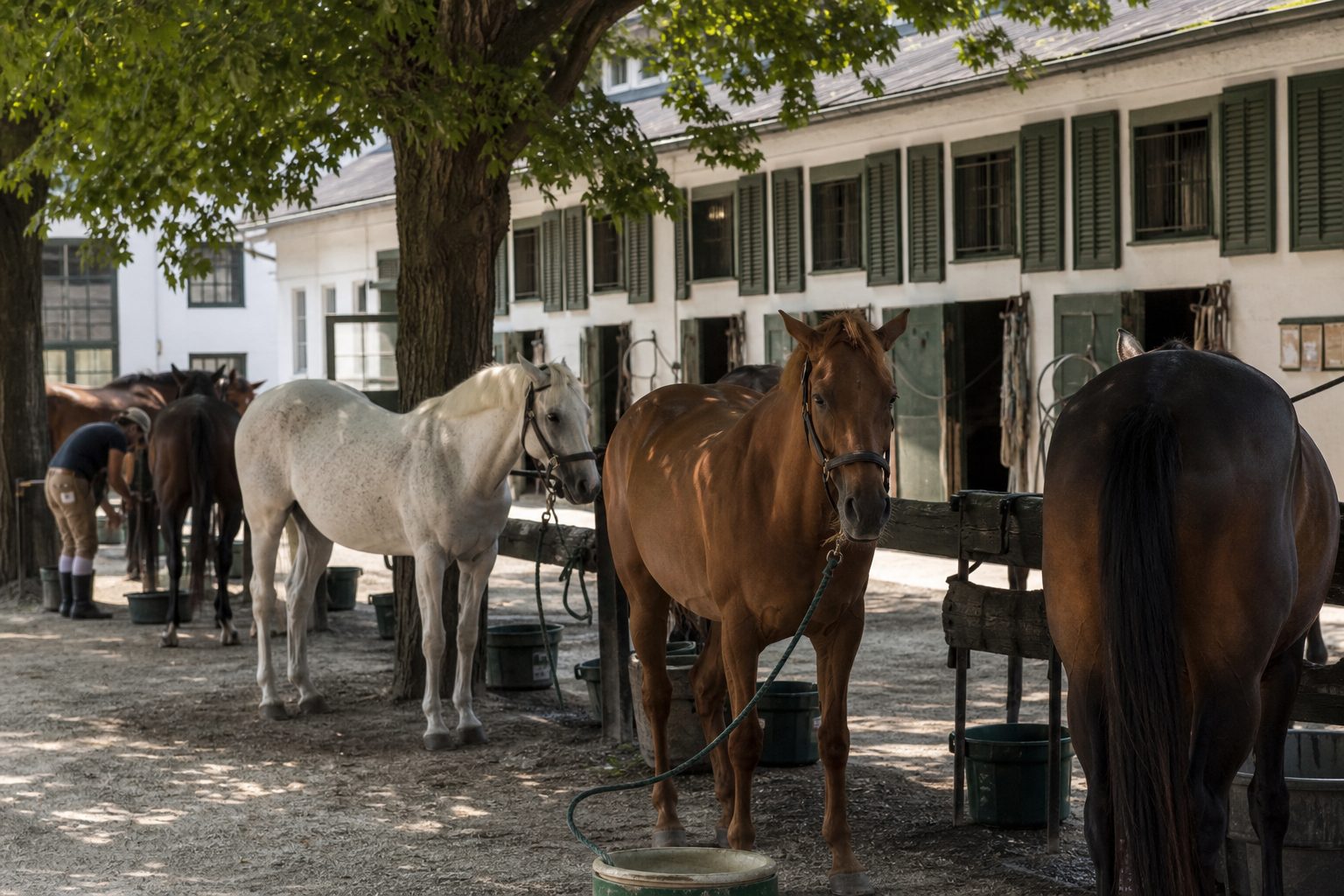
Back to back on the hour looks efficient on paper. In the aisle it is not, because the same horse going from a small child in a 15 inch saddle to an adult beginner needs a girth change, a stirrup change, sometimes a bit change, and a walk to cool out if the previous group finished at a trot.
Time the actual sequence once with a phone timer. Untack, sponge off, water, re tack for a different rider, walk to the mounting block. In most barns that is 12 to 18 minutes, and closer to 20 if the horse needs boots or the aide is also holding a pony for a lead line.
So build lessons at 50 minutes taught within a 60 minute block, or run 60 minute lessons in 75 minute blocks. The second is honest and the first is fine if the instructor genuinely stops teaching at :50 rather than treating it as a soft target.
A useful rule: any horse used in two consecutive slots needs a minimum 20 minute gap in summer. Any horse used in three consecutive slots needs a full hour off after the second.
Ignoring heat index and stacking afternoon lessons
Saturday afternoon is when families are free, so that is where the demand sits, and that is exactly the wrong place to put horses. In most of the country the heat index peaks between 2pm and 5pm.
Publish a tiered plan before June so you are not making the call under pressure with eight parents watching.
| Heat index | Lesson runs as | Horse rule |
|---|---|---|
| Below 90 | Normal | Normal limits |
| 90 to 95 | Normal with extra walk breaks | Max two lessons per horse per day |
| 95 to 103 | Flat work only, no jumping, shortened to 40 minutes | One lesson per horse, morning preferred |
| Above 103 | Canceled or moved to unmounted | No work, hose off and shade |
Those thresholds are a starting point rather than a standard, and a barn in Arizona with 12 percent humidity will set them differently than one in Georgia. The point is that the number is decided in advance and applies to everyone.
The practical scheduling move is to shift the summer week: heavier Saturday mornings starting at 7:30, an empty block from 1pm to 4pm, and evening lessons at 6pm. Families grumble in May and are grateful in July.
Keep reading: What should I check every morning before the first lesson of the day starts?
One instructor holding the whole schedule in her head
Every barn has this person. She knows that the chestnut mare cannot go behind the paint gelding in the ring, that one particular rider needs the quiet end of the arena, and that a certain family is always 15 minutes late.
The schedule runs beautifully until she has a wedding, a stomach bug, or a horse show she is coaching at. Then the substitute finds a grid of names and no context, and the first hot Saturday becomes the day everything undocumented surfaces at once.
Get it out of her head in writing. For each horse: rider level band, weight limit, tack setup, known quirks, and who must not ride him. For each rider: level, confidence notes, and any medical flag. It takes an afternoon and it is the single highest value hour of admin in a lesson barn.
Makeup lessons layered on top of a full week
Makeups accumulate quietly through the spring. Rain in April, a stomach bug going through the pony club, a family vacation. By mid June you owe 22 makeup lessons and the only way to deliver them is to squeeze them into a week that is already at capacity.
That squeeze always lands on the horses, because horses are the flexible resource in the moment even though they are the least flexible over a season. A makeup at 1pm on Saturday means a horse doing a fifth hour in the heat.
Offer makeups only from published open slots, never as an addition to a full block, and cap them per package. If you have no open slots, the honest answer is a credit rather than a lesson, and families accept that far better than a bad hot lesson on a tired horse.
See how BarnBooked handles this for equestrian riding schools
No substitute horse named for each booking
Horses come up sore. A shoe is pulled in turnout Friday night. An abscess blows at 6am. On an ordinary week you improvise, and on the first hot Saturday you have no slack to improvise with.
Name a second horse on every booking at the time you make it, not at the time you need it. It costs nothing and it is the difference between a 90 second adjustment and a 20 minute scramble that pushes the whole day late.
Two rules make the substitute real: the substitute must sit in the same rider level band as the first choice, and the substitute must have its own available hours that day. A backup that is already fully booked is not a backup.
A weekly review that catches these before they land
Thirty minutes, same time each week, ideally Wednesday so there is time to fix what you find. Work through the coming Saturday in this order.
- Every booking names a horse and a substitute.
- No horse exceeds its daily hours or its consecutive slot rule.
- Every horse to horse handoff has at least 20 minutes.
- The 1pm to 4pm block is empty or explicitly approved.
- Every rider is inside the level band of the horse assigned.
- Makeups sit only in slots that were already open.
- Waivers current and emergency contacts present for anyone new.
Run that list and most Saturdays stop being dramatic. The ones that still go sideways go sideways for a real reason, a thunderstorm or a colic, rather than because a pony was booked three times before eleven.
Where to start this week
Pick the two failures that cost you the most last summer, almost certainly the unbooked horse and the missing buffer, and fix those before you touch anything else. Write the per horse daily limit for every animal in the string. Then rebuild one Saturday against those limits and see what falls out.
BarnBooked exists to make that impossible to get wrong. A lesson cannot be booked unless the horse has hours left in its own limit, buffers between slots are enforced rather than hoped for, substitutes are named at booking time, and the workload report shows which horses are quietly carrying the program. Set the limits once and the schedule holds itself together on the days you are too busy to check.