field report
What actually happens when you match riders to horses by level instead of habit?
Most barns assign horses by who is free. Assigning by rider level and horse job changes lesson quality, horse longevity and complaints. Here is what that looks like day to day.
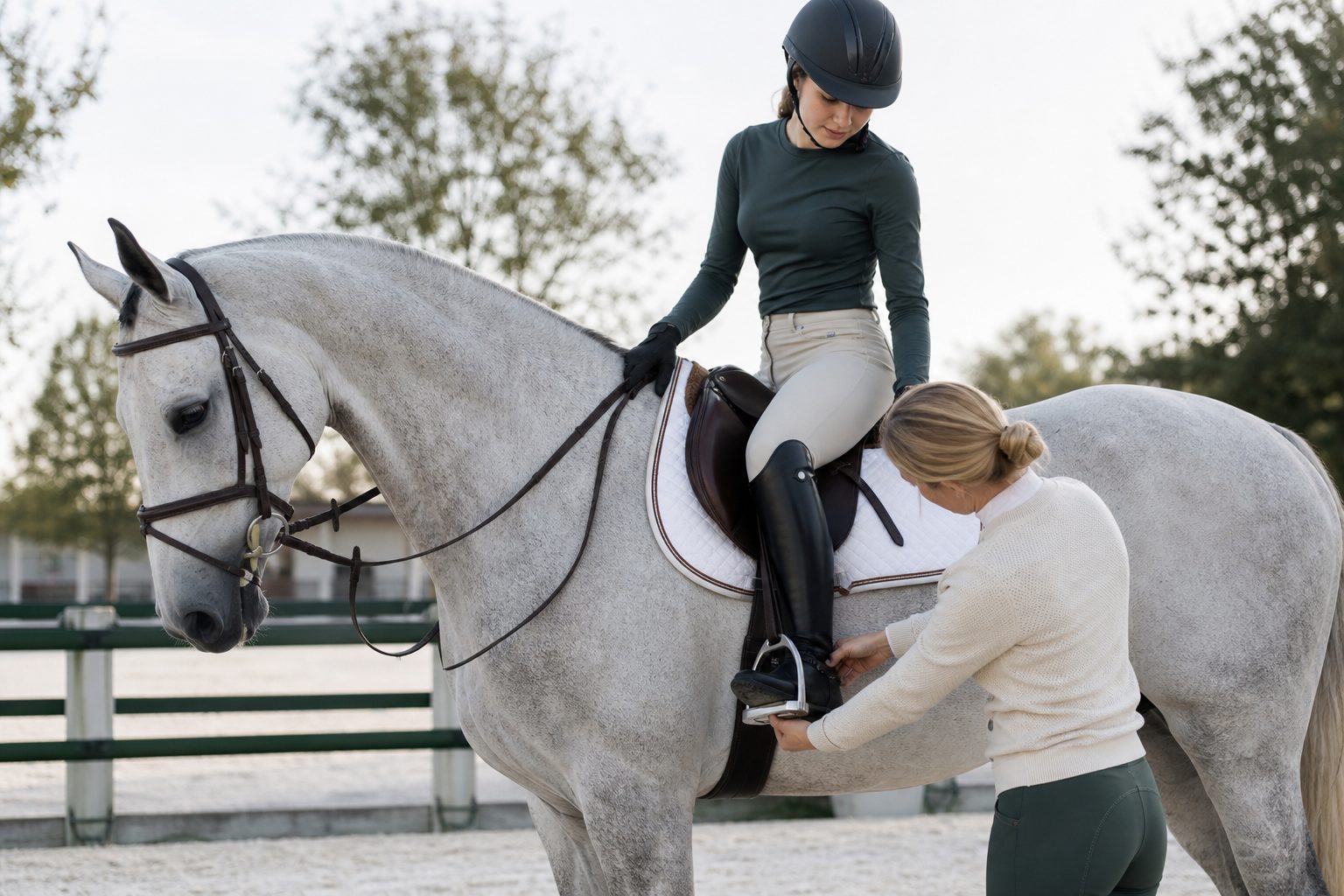
What happens is that your best three horses stop doing sixty percent of the work, your quiet ones start earning their keep, and about a third of your instructor's lesson plan gets made before she walks into the arena. You also get roughly two to four weeks of friction, mostly from parents, while people adjust to no longer riding the horse they consider theirs.
The change itself is small on paper. Instead of asking which horse is free at 5 p.m., you ask which horses are appropriate for this rider, then pick the one among those with the lightest week. That reordering of two questions is the whole intervention.
What follows is what it looks like in a working barn, including the parts that are uncomfortable.
How habit based assignment forms in a busy barn
Nobody decides to assign horses by habit. It accumulates. An instructor puts a nervous kid on the steady bay because it is the safe call that day. It goes well. She does it again. Within six weeks the kid has a horse, the parent has learned his name, and reassignment now requires a conversation.
Multiply that by forty riders and you get a barn where five or six horses are effectively spoken for and the rest fill in. The pattern is reinforced by every pressure in the building. Substitutes go to the horse the instructor knows. New students go to the horse everyone agrees is safe. Evening slots, the busiest ones, go to whoever is standing tacked in the aisle.
The tell is in the numbers. Pull last month's lessons and count rides per horse. If your top three horses are carrying two or three times what your bottom five carry, you do not have a scheduling system. You have a habit with a whiteboard attached.
Keep reading: How many lessons a week can one school horse actually carry before he sours?
Defining rider levels the whole staff reads the same way
Level matching fails when levels are vague. "Intermediate" means whatever the instructor saying it means. You need levels defined by observable skills, so that two instructors watching the same rider place her identically.
Keep it to four or five bands and define each by what the rider can do without help:
| Level | Can do unassisted |
|---|---|
| 1 Beginner | Mount, halt, walk, steer, sit trot briefly on the lunge or led |
| 2 Advancing beginner | Post the trot on the correct diagonal, walk trot transitions, ride independently in a group |
| 3 Intermediate | Canter both leads on request, hold a circle, ride a horse that needs leg |
| 4 Advancing | Correct a horse that anticipates, jump a small course, adjust stride |
| 5 Advanced | Ride a green or opinionated horse productively, school through a problem |
Write these on one page and put it in the tack room. Then do a calibration session: three instructors watch the same four riders and place them independently. Where they disagree, the definition needs sharpening. That afternoon costs you three hours and pays back all season.
Giving each horse a job description and a rider band
Now do the same for the horses. Every horse gets a short written job description, and it is more specific than "good beginner horse."
A useful horse card carries five things: the rider levels the horse suits, what the horse teaches well, what the horse will not tolerate, the maximum lessons per day and per week, and any standing restrictions.
Dutch, 16, levels 2 to 4. Teaches leg and forward. Will not tolerate a rider who hangs on his mouth. Max 3 lessons per day, 12 per week. No jumping over 2 feet. Left hind gets stiff, needs a longer warmup.
Notice that the level range is a band, not a ceiling. A horse that is fine for level 4 may be actively bad for level 1, because he needs a rider with an independent seat. Writing "levels 2 to 4" prevents the beginner assignment that everyone would otherwise make on a busy Tuesday.
The horse card is also where your workload limit becomes real. Three per day, twelve per week is not a suggestion. It is the constraint the schedule has to respect, and it is the reason a level matched barn also ends up with a healthier string.
Keep reading: What does a riding instructor liability release actually have to say to hold up?
The first weeks: pushback from students and parents
Expect it. The complaints are predictable and they come in three flavors.
The first is attachment. A child has ridden the same pony for two years and now rides three different horses. This is the hardest one because the feeling is genuine. It helps to reframe it in front of the parent as progress: your daughter is ready for a horse that asks more of her, and riding several horses is how riders actually learn.
The second is fairness. A parent notices another child gets the popular horse more often. Publishing the level definitions defuses most of this, because the assignment now has a stated reason that is not favoritism.
The third is fear, usually from adults. An adult beginner who has found one horse she trusts does not want to be moved. Move her more slowly. Introduce a second suitable horse alongside the first rather than replacing it, and let her keep alternating for a month.
Say it to families before you start, not after they notice. A short note explaining that horses now have written workload limits and rider bands, and that assignments follow those, converts a grievance into a policy.
Effect on horse soundness and behavior over a season
The soundness effect is mostly a workload effect. A horse doing five lessons on a Saturday because he is the one everyone trusts accumulates concussion and fatigue that shows up months later as a maintenance problem. Capping him at three, and sending the other two to horses who were doing one, spreads the same total work across more legs.
The behavioral effect is more immediate and more visible. Horses get sour from being asked the same wrong question repeatedly. The horse who needs a rider with quiet hands, given three hanging beginners a week, starts to invert, then to hollow through transitions, then to refuse. Instructors read that as the horse getting difficult. It is usually the horse being clear.
Match him to riders in his band and much of it resolves without any training intervention at all. Barns commonly find that one or two of their "problem" horses were never problems, they were mismatched. That is a real horse recovered, at whatever a replacement school horse costs in your market.
See how BarnBooked handles this for equestrian riding schools
What it does to instructor prep time
Prep time goes up in month one and down after that. In month one instructors are learning the cards and arguing about levels. By month three they walk into a lesson already knowing more about the pairing than they used to know at the end of it.
The gain is that the lesson plan narrows itself. If a level 2 rider is on a horse whose card says he teaches forward and will not tolerate hands, the instructor knows before she starts that the lesson is about leg and about a following rein. She is not spending the first fifteen minutes discovering the mismatch.
The other gain is substitution. When an instructor calls out, the person covering can read the cards and teach a lesson she did not plan, because the pairing already encodes what matters. Habit based barns cannot do this, which is why coverage there so often defaults to a walk trot hack.
Where level matching should be overridden
A rule you never break is a rule that will eventually hurt a horse or a rider. There are four situations where the assignment should be overridden deliberately, and the override should be recorded.
- A rider coming back from a fall or injury. Drop a level, or drop to the quietest suitable horse, regardless of what she was riding before. Confidence does not return on schedule.
- A horse who is technically within his limit but is not himself. The card says twelve a week and he has had nine. If he is dull or tight, he is done. The limit is a ceiling, not a quota to fill.
- Weather and footing. Deep or slick footing pushes every pairing conservative. A horse who suits a level 3 in good going may need a level 4 in mud.
- A specific teaching goal. Putting a strong level 4 on the beginner horse for one lesson to work on position without the horse arguing is good teaching, not a violation. Put it in the notes so it does not become the new habit.
The discipline is that overrides are named as overrides. An unrecorded exception is how habit reconstitutes itself, one reasonable decision at a time.
Getting the rule to hold
Level matching is not hard to decide. It is hard to sustain, because every booking made at speed is an opportunity to fall back on who is free. Paper cards in the tack room work for a month and then live in a drawer.
It holds when the constraint sits inside the booking itself. BarnBooked keeps the rider's level, the horse's suitable band and the horse's daily and weekly work limit together, so a booking that breaks the match or exceeds the limit is caught when it is made rather than discovered in the arena. The judgment is still yours. The bookkeeping stops being.